
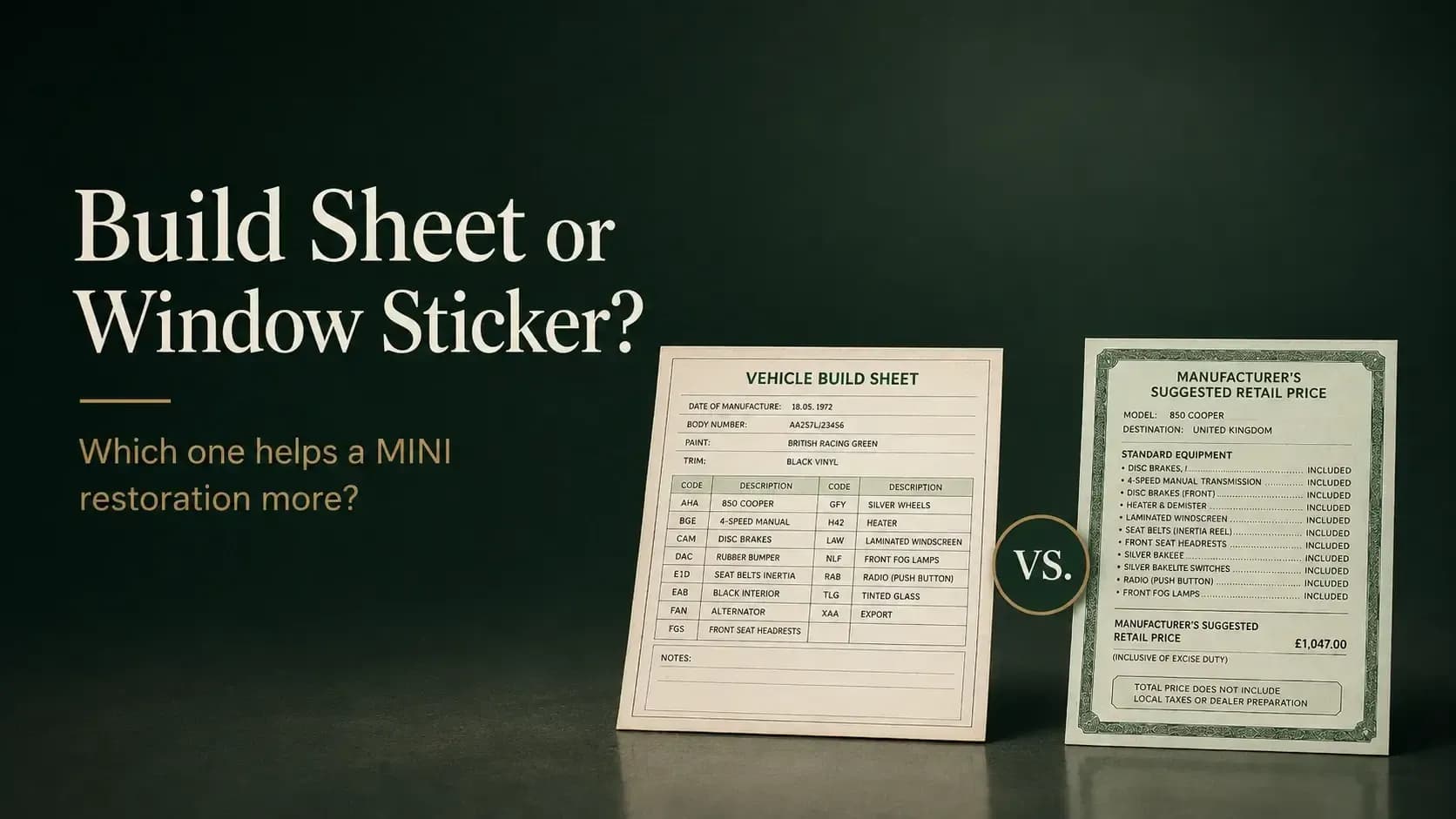
For a factory-focused MINI restoration, use both documents when possible. The build sheet is usually the stronger technical reference because it identifies the original factory configuration. The window sticker adds retail-era details such as MSRP, standard equipment, paid packages, destination charges, and fuel economy.
When only one document is available, start with the MINI build sheet by VIN. It gives the project a clear factory baseline. The window sticker can then strengthen the restoration record and explain how the completed MINI was originally presented to its first buyer.
Key Takeaways
- A build sheet is generally the stronger starting point for factory configuration.
- A window sticker adds original pricing, package, equipment, and retail context.
- Neither document proves what remains on the MINI today, so physical inspection is still essential.
What Is the Difference Between a MINI Build Sheet and a Window Sticker?
A build sheet and window sticker can show some of the same vehicle details, but they serve different jobs. The build sheet focuses on how the MINI was configured at the factory. The window sticker explains the finished vehicle, equipment, and price to a retail buyer.
| Restoration question | Build sheet | Window sticker |
|---|---|---|
| Original paint and interior | Strong reference | Often included |
| Engine and transmission | Strong reference | Usually included |
| Factory option codes | Often more detailed | May show package names |
| Standard equipment | May be summarized | Clearly presented |
| Paid options and prices | Sometimes limited | Strong reference |
| Original MSRP | Not usually the focus | Clearly presented |
| Destination charge | Not usually the focus | Usually included |
| Fuel economy and warranty | Often limited | Usually included |
| Current condition | Not shown | Not shown |
← Scroll horizontally to see more →
The Build Sheet Records Factory Configuration
A factory build sheet for restoration helps confirm how the MINI was originally assembled. Depending on available records, it may identify the engine, transmission, paint, upholstery, wheels, packages, trim details, and production equipment.
It works like the technical foundation of the restoration. Before buying parts or removing current components, the restorer can compare the car with its documented factory specification.
The Window Sticker Records Retail Presentation
The window sticker shows how the completed MINI was presented for sale. It commonly includes the base MSRP, standard features, paid options, destination charge, total price, fuel economy, warranty details, and safety information.
Think of it as the car’s original showroom résumé. It tells the story buyers saw when the MINI was new.
Their Shared Details Help Confirm Accuracy
Both records may show the model, engine, transmission, exterior color, interior trim, and major packages. Matching details increase confidence that the document belongs to the correct MINI.
When the records disagree, verify the VIN, model year, and source before using either document as restoration evidence.
Their Different Details Prevent Assumptions
The build sheet may show production information that the retail sticker summarizes under a package name. The sticker may show prices and sales information that the build sheet does not emphasize.
That difference is useful rather than inconvenient. Each document fills gaps left by the other.
The guide to reading a MINI window sticker section by section explains how to interpret its equipment, pricing, fuel-economy, and warranty sections.
Which Restoration Decisions Does Each Document Support?
The documents become most useful when tied to specific restoration choices. The build sheet usually guides technical authenticity, while the window sticker helps explain equipment groups, original cost, and provenance.
Four areas show how they work together.
Original Paint and Interior
The build sheet may identify the factory exterior color, upholstery, interior color, and trim combination. The window sticker can confirm the named color and interior description used when the MINI was sold.
Together, they help determine whether the current paint, seats, dashboard surfaces, carpets, and door trim match the original configuration.
Powertrain and Factory Equipment
The build sheet is usually the stronger reference for the original engine, transmission, drivetrain, wheels, and production equipment. The window sticker can confirm how those features were described as standard or optional.
This matters when a MINI has received an engine swap, transmission conversion, suspension change, or later equipment upgrade.
Packages and Appearance Features
A build sheet may list individual equipment details or factory codes. A window sticker may group those same features under recognizable package names and show what each package originally cost.
That context helps identify whether sport seats, premium audio, navigation, lighting, wheels, or John Cooper Works details belong to the original build.
Provenance and Resale Presentation
The window sticker adds value when documenting the completed restoration. Original MSRP, package prices, destination charges, and standard equipment are easy for buyers and appraisers to understand.
The build sheet supports those claims with a more technical factory record. One explains the specification; the other helps present its significance.
For equipment that may have been added after production, review factory-installed, dealer-installed, and aftermarket MINI options.
Can You Restore a MINI Using Only One Document?
Yes, but the result may contain unanswered questions. One document can provide a useful starting point, yet an authenticity-focused restoration becomes stronger when the available build sheet, window sticker, physical vehicle, and supporting records agree.
Consider these four situations.
Using Only a Build Sheet
A build sheet may provide enough detail to begin restoring the original paint, interior, powertrain, wheels, and equipment. It is especially useful when the current car has been modified.
Its limitation is context. It may not clearly show original option prices, total MSRP, destination charges, or the retail presentation of the vehicle.
Using Only a Window Sticker
A window sticker can confirm major factory details, package names, standard equipment, paid options, and original pricing. It may be enough for a light cosmetic restoration or documentation project.
However, it may summarize a package without identifying every production detail needed for a factory-correct rebuild.
Using Neither Without Physical Inspection
Neither document proves that the parts currently on the MINI are original. Paint may have changed, body panels may have been replaced, and interior or mechanical parts may have been swapped.
The records describe the original vehicle. An inspection establishes what remains today.
Working When One Record Is Missing
When only one factory document is available, combine it with VIN verification, production-date data, part numbers, dealer invoices, photographs, and specialist inspection.
The missing document weakens the evidence trail, but it does not make a careful restoration impossible.
The same principle applies when comparing a window sticker vs build sheet for classic cars: the strongest conclusion comes from several records supporting the same specification.
How Should You Use Both Documents During a MINI Restoration?
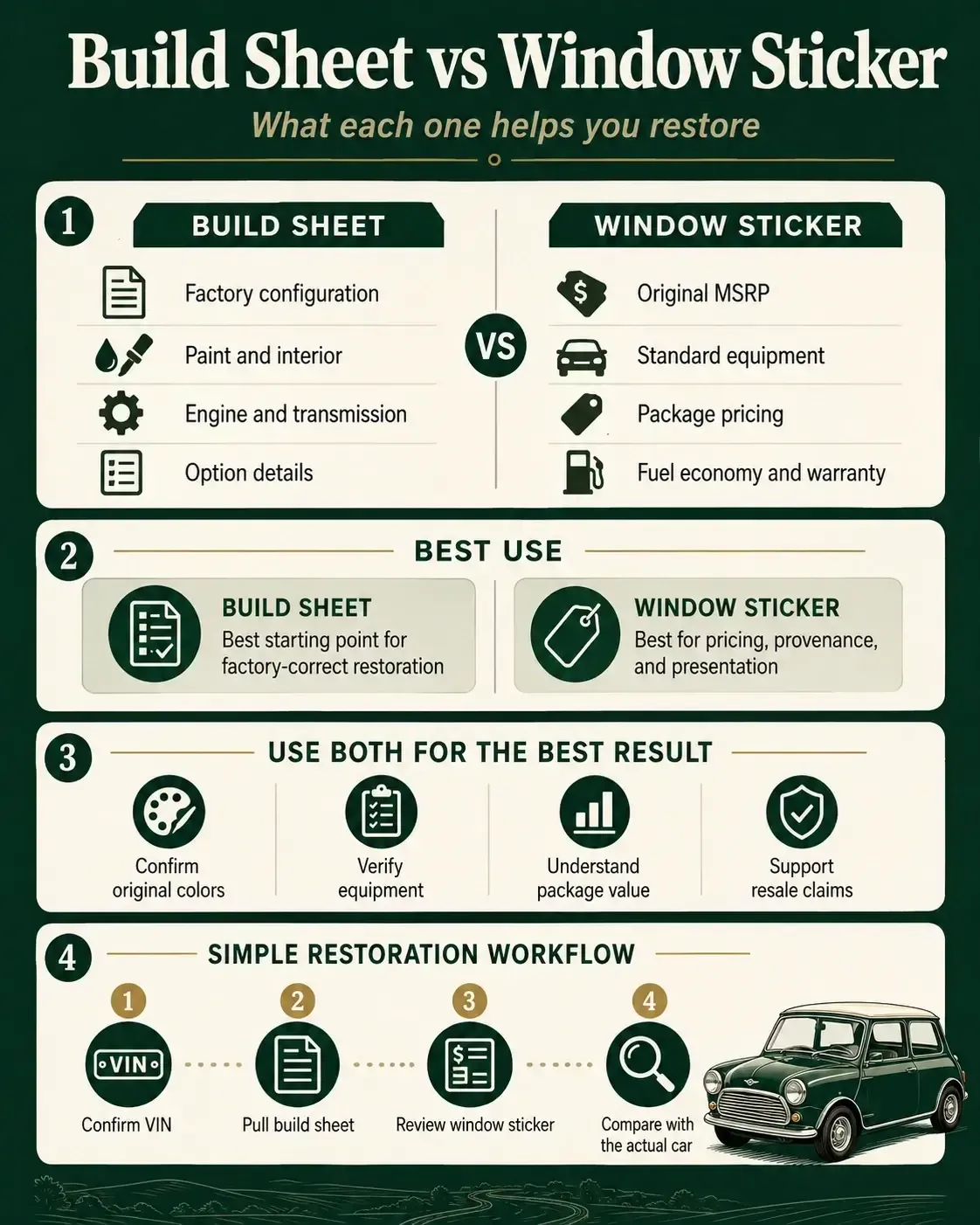
Use one repeatable process before removing parts or ordering expensive materials. This keeps the factory specification, current condition, and planned changes clearly separated.
Confirm the VIN
Match all 17 characters across the MINI, title, registration, and factory documents.
Record the Build Specification
List the original paint, interior, powertrain, wheels, packages, and production equipment.
Review the Window Sticker
Confirm the standard features, paid options, original MSRP, destination charge, and total price.
Inspect the Current Vehicle
Compare the documented specification with the paint, trim, mechanical parts, wheels, and accessories now fitted.
Classify Every Difference
Mark each mismatch as missing, replaced, modified, dealer-installed, damaged, or still uncertain.
Build the Restoration Plan
Decide which components should be preserved, repaired, sourced, replaced, or clearly disclosed.
Pro Tip: Use a spreadsheet with four columns: factory specification, current condition, planned action, and supporting evidence. This keeps small discrepancies from disappearing during a long restoration.
What Does a 2015 MINI Cooper Convertible Example Reveal?
The supplied 2015 MINI Cooper Convertible with VIN WMWZN3C53FT861789 shows why both documents can matter. Its factory record includes a distinctive color combination, manual transmission, original wheel specification, and several costly packages.
| Detail | Recorded specification |
|---|---|
| Exterior color | Pepper White |
| Interior | Carbon Black with SensaTec Leatherette |
| Engine | 1.6-liter four-cylinder |
| Transmission | Getrag six-speed manual |
| Wheels | 16-inch six-star twin-spoke alloy |
| Tires | P195/55R16 run-flat |
| Base MSRP | $25,700 |
| Total vehicle price | $39,600 |
← Scroll horizontally to see more →
The Color Record Guides Cosmetic Work
Pepper White exterior paint and Carbon Black SensaTec upholstery establish the original visual combination. A restorer can compare those details with the paint, roof, seats, dashboard surfaces, and trim currently on the car.
If the current MINI is another color, the record creates a clear starting point for investigating a repaint.
The Powertrain Record Supports Authenticity
The recorded 1.6-liter engine and Getrag six-speed manual transmission help confirm the original mechanical configuration. That becomes valuable if the car has undergone an engine replacement or transmission conversion.
A functioning replacement part may be perfectly usable, but it should not be described as original without evidence.
The Packages Explain Special Features
The vehicle’s recorded equipment includes John Cooper Works interior and exterior packages, a Highgate Package, Sport Package, Technology Package, MINI Connected equipment, xenon headlights, and Chrome Line details.
Those packages explain why certain steering-wheel, trim, lighting, navigation, and appearance components may belong to the original specification.
The Original Price Adds Provenance
The vehicle started with a $25,700 base MSRP but reached a total price of $39,600 after packages, equipment, and shipping.
That difference shows why returning the car to its documented configuration may matter. Its options were not minor extras; they formed a large part of its original identity and value.
For a restoration involving faded or missing color information, follow the guide on finding a MINI paint code when the label is unreadable.
What Should Buyers and Flippers Verify After the Restoration?
A polished restoration can look convincing while still containing unsupported originality claims. Buyers and flippers should compare the finished car with the documentation before assigning extra value to words such as “original” or “factory-correct.”
Four checks matter most.
✓ Match the Vehicle to the Records
Compare the finished paint, upholstery, powertrain, wheels, packages, and trim with the documented factory configuration. Record any remaining differences clearly.
A modification is not automatically a flaw. The problem begins when a later addition is presented as original equipment.
✓ Separate Receipts From Factory Evidence
Restoration receipts prove that parts and labor were purchased. They do not prove that those components were fitted when the MINI was built.
Factory documents support original configuration. Invoices support the restoration work completed later.
✓ Inspect the Quality of the Work
Correct specifications do not guarantee good execution. Check paint finish, panel alignment, corrosion repair, wiring, upholstery fit, mechanical condition, and installation quality.
Factory-style parts fitted poorly do not create a high-quality restoration.
✓ Read the Sales Description Carefully
Terms such as restored-to-original, factory-correct, period-correct, dealer-installed, and modified have different meanings. The listing should reflect the available evidence.
When the wording and documents conflict, ask the seller to explain which parts were restored, replaced, or added later.
See why a used MINI listing may not match its original window sticker before relying on a seller’s equipment description.
Pro Tip: Photograph option labels, part numbers, hidden paint areas, and date markings before final assembly. These images can support authenticity claims after the finished parts cover the evidence.
Conclusion: Let the Build Sheet Guide the Work and the Window Sticker Complete the Story
For build sheet vs window sticker restoration, the strongest answer is to use both.
The build sheet should usually lead the technical work. It helps establish the original powertrain, paint, interior, wheels, equipment, and factory packages. That makes it the better starting point for a serious car restoration build sheet workflow.
The window sticker adds the retail story. It shows how the MINI was equipped, priced, and presented to its first buyer. It can also make the completed restoration easier for future buyers, appraisers, and enthusiasts to understand.
Neither document proves the current condition of the vehicle. Compare both with the physical MINI, production details, part numbers, photographs, and restoration receipts before describing the result as factory-correct.
Once the work is complete, retrieve the MINI window sticker by VIN and keep it with the build sheet and restoration file. Together, the documents create a clearer and more credible record of what the MINI was—and what the restoration brought back.