
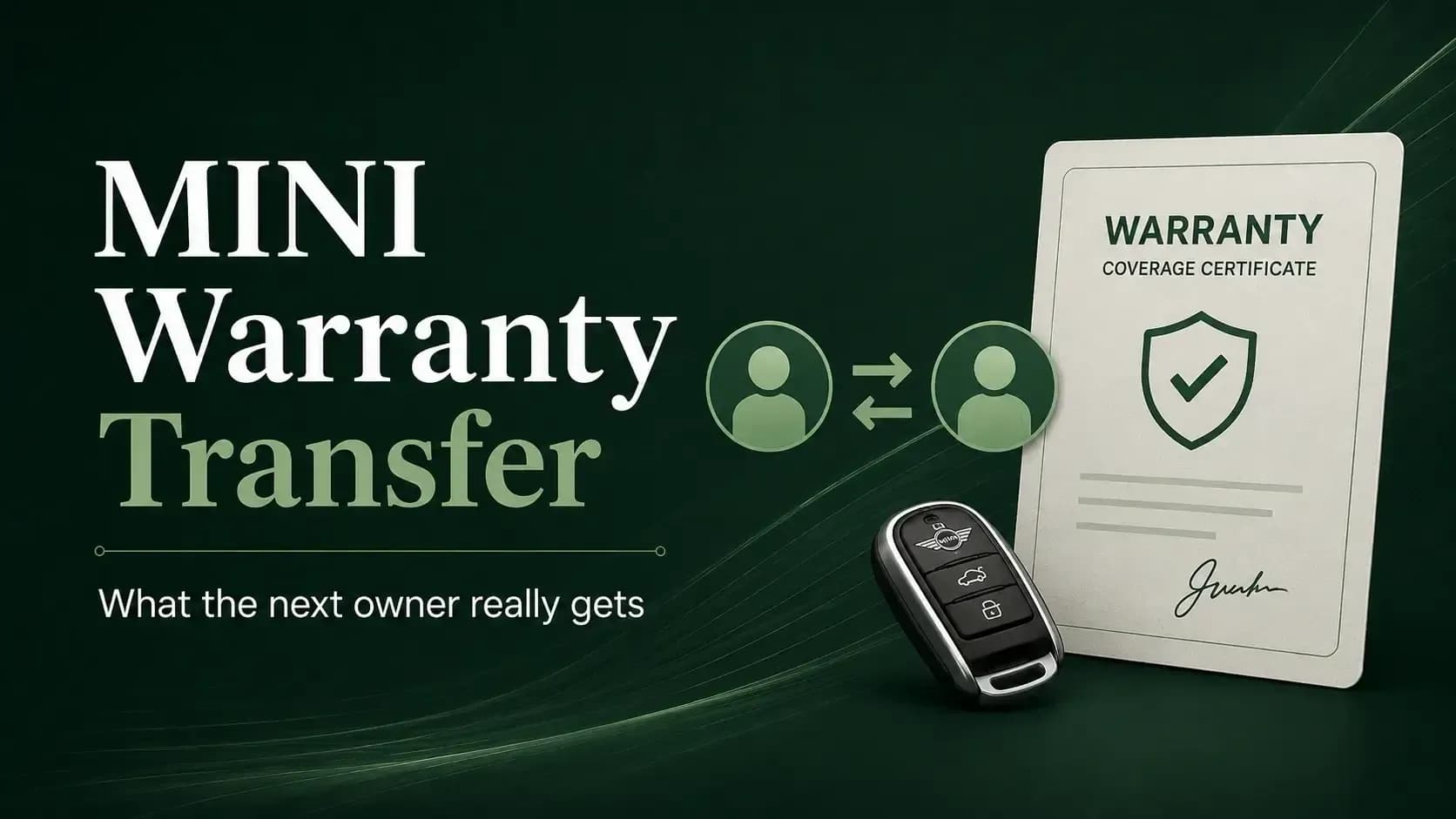
Yes. For a U.S.-specification MINI, the remaining New Passenger Car Limited Warranty generally follows the vehicle to the next owner. MINI’s 2025 warranty booklet states that coverage applies to the first retail purchaser and each subsequent purchaser.
There is an important catch, though: not every MINI benefit transfers under the same rules. Certified Pre-Owned coverage requires a formal application and fee, while complimentary scheduled maintenance is usually tied to the first owner.
Before buying, check the vehicle’s original in-service date, mileage, and coverage type through a MINI warranty check by VIN.
Key Takeaways
- MINI’s remaining new-vehicle limited warranty covers subsequent purchasers, but the original time and mileage limits do not restart.
- MINI Certified Pre-Owned warranty transfer requires paperwork, eligibility checks, and a transfer fee.
- Complimentary scheduled maintenance usually does not transfer to an unrelated second owner.
Does the MINI Factory Warranty Follow the Car?
The standard MINI new-vehicle warranty is written to cover the vehicle’s first retail buyer and later purchasers. In plain English, the remaining coverage follows the MINI rather than staying with the person who bought it new.
Still, “transferable” does not mean fresh coverage. Four rules shape what the next owner receives.
The Next Owner Gets Only the Remaining Coverage
For 2025 U.S.-specification models, MINI’s New Passenger Car Limited Warranty lasts 48 months or 50,000 miles, whichever comes first. The clock begins at the first retail sale or when the vehicle was first placed into service, whichever happened earlier.
Suppose you buy a three-year-old MINI with 38,000 miles. You do not receive another four years and 50,000 miles. You receive whatever remains before the original time or mileage limit is reached.
A Dealer Demonstrator May Have an Earlier Start Date
The warranty may begin before the date shown on a later buyer’s sales contract. A vehicle used as a demonstrator, company car, or qualifying mobility-program vehicle can have an earlier original in-service date.
That detail matters. A MINI advertised as “only two years old” may have less factory coverage left than its registration year suggests.
The Original Conditions Still Apply
A new owner receives the remaining warranty under the same exclusions and limitations. Ownership changes do not turn wear items, accident damage, neglected maintenance, or unauthorized tuning into covered defects.
The warranty follows the vehicle. So does its prior condition.
The Coverage Is Market-Specific
The 2025 MINI warranty booklet applies to U.S.-specification vehicles distributed by MINI USA, with qualifying warranty work performed by an authorized MINI dealer in the United States or Puerto Rico. An imported MINI may have different coverage or no usable U.S. coverage under that booklet.
That is why a VIN check matters more than a seller saying, “It should still be under warranty.”
Which MINI Warranty Benefits Transfer and Which Ones Do Not?
The phrase “factory warranty” is often used as a catch-all. In reality, a MINI may have several separate programs running at the same time, and each can follow different rules.
Here is how the main types compare.
New Passenger Car Limited Warranty
This is the core factory warranty against covered defects in materials or workmanship. MINI’s 2025 booklet expressly includes the first retail purchaser and each subsequent purchaser.
The booklet does not list a separate ownership-transfer application or fee for this standard coverage. In practical terms, the remaining warranty follows the eligible vehicle, although the new owner should still update ownership information and confirm the VIN with a MINI dealer.
MINI Certified Pre-Owned Limited Warranty
CPO coverage is transferable, but it does not transfer as casually as the original new-vehicle warranty. MINI provides a dedicated transfer application for a qualifying private-owner-to-private-owner sale.
The application requires proof of ownership change and mileage, a notarized seller statement, and a $200 warranty transfer fee. The buyer must apply within 60 days, and the vehicle must still meet the CPO transfer rules.
Complimentary Scheduled Maintenance
MINI’s complimentary maintenance program is generally not transferable to an unrelated second buyer. For covered recent U.S. models, MINI states that the benefit belongs to the initial purchaser, owner, or lessee.
There is a limited exception for qualifying household transfers, such as a transfer to a spouse, child, sibling, parent, grandparent, or grandchild. MINI advises owners to notify the dealer so the household transfer can be documented.
Roadside, Accessories, and Extra Protection
Roadside Assistance, accessory warranties, maintenance extensions, and optional protection plans are separate products. Their duration and transfer terms should not be assumed from the new-vehicle warranty alone.
For example, MINI states that new-vehicle Roadside Assistance begins on the original in-service date, while accessories installed after the retail sale may have coverage based on the remaining vehicle warranty or a separate parts-warranty period.
How Do You Check and Transfer Remaining MINI Warranty Coverage?

Use this six-step process before paying for a used MINI. It separates confirmed coverage from optimistic seller wording.
Confirm the VIN
Match all 17 characters on the vehicle, title, registration, and sales documents.
Find the In-Service Date
Ask a MINI dealer when the vehicle’s original warranty clock began.
Record the Current Mileage
Compare the odometer with the applicable warranty mileage limit.
Identify the Coverage Type
Separate the new-vehicle warranty, CPO warranty, maintenance program, and private service contract.
Request the Correct Paperwork
For CPO coverage, obtain the transfer form and submit it within the required period.
Get Written Confirmation
Ask the dealer or warranty administrator to confirm the remaining coverage attached to the VIN.
If the decoded model or trim does not match the car, resolve that issue first. The guide to why a MINI VIN decoder may show the wrong trim explains why incorrect vehicle identification can also lead to incorrect warranty assumptions.
Pro Tip: Do this before purchase, not after. A five-minute VIN check is far cheaper than discovering that the “remaining warranty” was actually nontransferable maintenance or an expired service contract.
What Can End or Limit Transferred Factory Coverage?
A change of owner does not erase the warranty, but it also does not erase the vehicle’s history. Certain conditions can exclude a claim or void coverage for affected components.
Six issues deserve close attention.
❌ Odometer or VIN Problems
MINI’s warranty may become void if the odometer was altered and the true mileage cannot be determined, or if the VIN was altered or cannot be verified.
For a used-car buyer, mismatched VIN labels or unexplained mileage gaps are not minor paperwork quirks. They can affect both value and coverage.
❌ Salvage or Total-Loss History
The warranty booklet states that coverage may be void when the vehicle has been declared a total loss or sold for salvage purposes. Competitive use can also affect coverage.
A clean-looking rebuild may still carry a title or insurance history that changes its warranty position.
❌ Aftermarket Tuning and Modifications
A modification does not automatically erase every part of the warranty. However, MINI states that coverage for affected drivetrain or emissions components can be void when a nonapproved modification or tuning product caused the failure.
That distinction matters for modified Cooper S and John Cooper Works models. A tune may not cancel an unrelated window-motor claim, but it could create a serious dispute over engine or turbocharger damage.
❌ Accident or Improper-Repair Damage
Damage resulting from accidents, improper repair, misuse, or environmental causes is not treated as a defect in factory materials or workmanship.
A transferred warranty is not a substitute for a vehicle-history report or a proper pre-purchase inspection.
❌ Wear and Maintenance Items
Brake friction materials, filters, fluids, upholstery wear, glass damage, paint deterioration, and similar items may have limited coverage or be excluded unless there is a genuine manufacturing defect.
That is why “bumper-to-bumper” should not be read as “every possible repair is free.”
❌ Damage Caused by Neglect
The warranty does not cover failures caused by improper maintenance, unsuitable fluids, contaminated fuel, or other owner-related neglect.
A full service history is useful not because missing receipts automatically cancel the entire warranty, but because records can help show that the claimed failure was not caused by poor care.
A 2015 MINI Example: Transferable Does Not Mean Reset
Consider the supplied 2015 MINI Cooper Convertible sample with VIN WMWZN3C53FT861789.
Its original factory information listed these coverage periods:
| Original program | Original coverage |
|---|---|
| Basic limited warranty | 48 months / 50,000 miles |
| Powertrain coverage | 48 months / 50,000 miles |
| Complimentary maintenance | 36 months / 36,000 miles |
| Rust-perforation coverage | 144 months / unlimited miles |
| Roadside assistance | 48 months / unlimited miles |
← Scroll horizontally to see more →
A buyer in 2017 might have received some remaining basic warranty because the vehicle was still within the original term. A buyer in 2026 would not revive that expired four-year coverage simply by becoming the next owner.
The longer rust-perforation period may still be relevant, depending on the original in-service date, vehicle condition, applicable booklet, and exclusions. That is the practical meaning of used-car factory warranty coverage: the benefit can follow the car, but only until its original limit runs out.
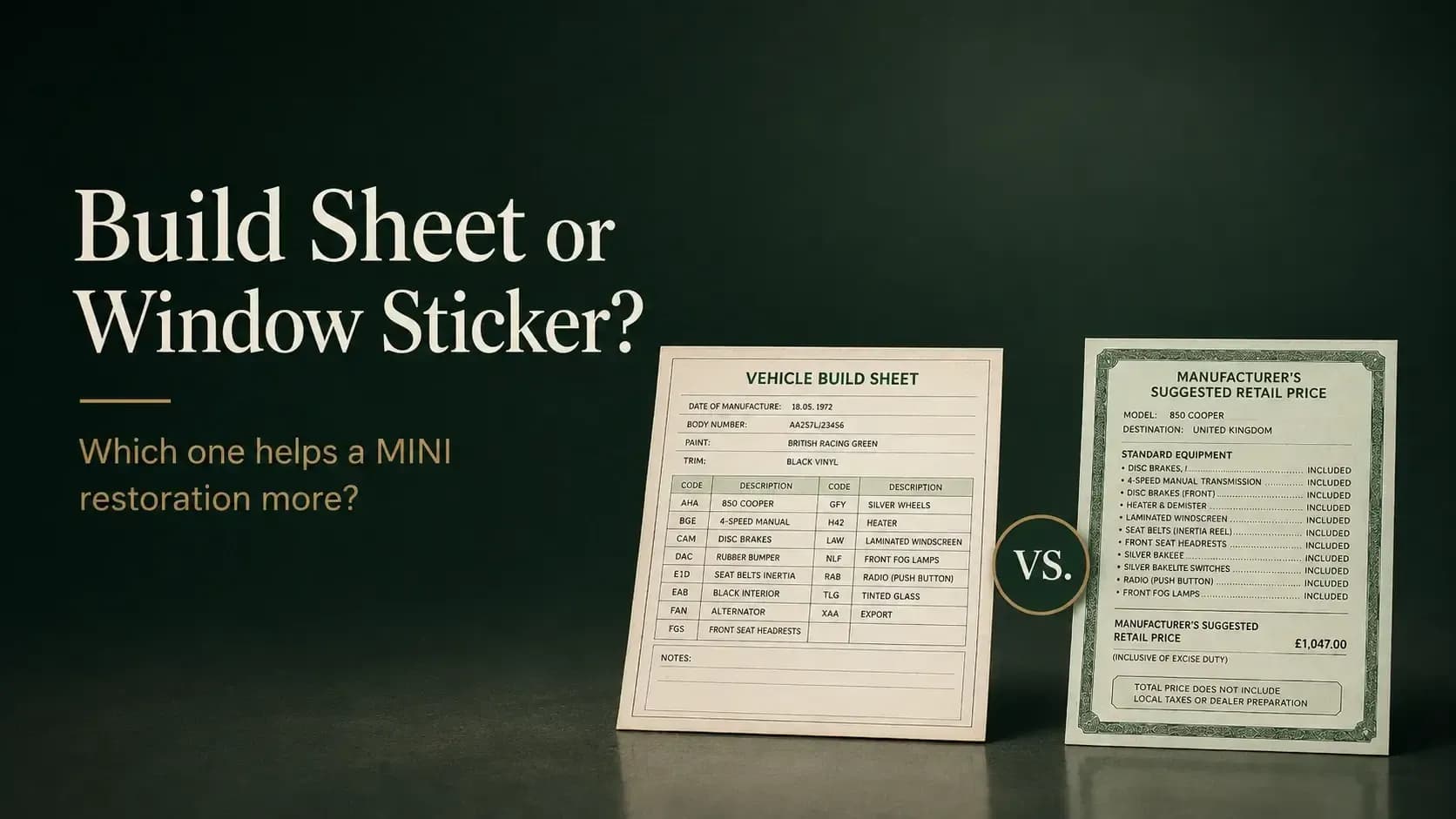
The guide to reading a MINI window sticker section by section can help distinguish original warranty information from later protection plans added by a dealer or owner.
What Should Used-MINI Buyers and Car Flippers Verify?
A remaining warranty can make a used MINI easier to sell, but only when the claim is specific and documented. “Factory warranty included” is too vague for a serious buyer.
Check these four areas before using warranty coverage as part of the vehicle’s value.
Verify the Exact Expiration Point
Ask for both the original in-service date and current mileage. The coverage ends when the first applicable limit is reached, not when the second owner expects it to end.
Write the date and mileage down. Do not rely on a dashboard message or listing description.
Separate Warranty From Maintenance
A seller may say “everything is still covered” when they actually mean the car has complimentary maintenance left. Those are different benefits—and MINI’s scheduled maintenance normally does not transfer to an unrelated buyer.
The reverse can happen too: maintenance may be gone while the defect warranty remains active.
Check Whether the Car Is Truly CPO
A used MINI sold by a dealer is not automatically a MINI Certified Pre-Owned vehicle. Ask for proof of certification and the applicable CPO coverage documents.
If the current owner bought it as CPO and is now selling it privately, the next buyer must follow MINI’s transfer process, including the application deadline and fee.
Confirm the Coverage in Writing
Ask an authorized MINI dealer or MINI Customer Relations to confirm what remains on the VIN. MINI publishes model-year warranty booklets through its official warranty and maintenance page, making it possible to check the terms that apply to that particular model year.
For sellers and flippers, written confirmation also makes the listing cleaner. You can state the exact remaining coverage rather than waving vaguely at the word “warranty.”
A seller’s description may not match the original vehicle record. See why a used MINI listing can differ from its window sticker before relying on broad claims about trim, equipment, or included benefits.
Pro Tip: Use wording such as “remaining MINI New Passenger Car Limited Warranty through [date] or [mileage], subject to MINI terms.” It is clearer and safer than claiming the vehicle is “fully covered.”
Conclusion: The Warranty Usually Follows the MINI, but the Details Matter
So, is a factory warranty transferable to the next MINI owner? For the standard U.S. MINI New Passenger Car Limited Warranty, yes—the booklet covers the first retail purchaser and each subsequent purchaser. The new owner receives only the time and mileage remaining from the vehicle’s original in-service date.
CPO coverage is different. It requires a formal transfer application, supporting documents, a qualifying private sale, and a $200 fee. Complimentary scheduled maintenance is different again: it usually stays with the first owner unless the vehicle moves through an eligible household transfer.
That mix of rules is why a verbal promise is not enough.
Before buying or advertising a used MINI, check its original warranty information by VIN, confirm the current mileage and in-service date, and ask MINI to verify the remaining coverage in writing.