
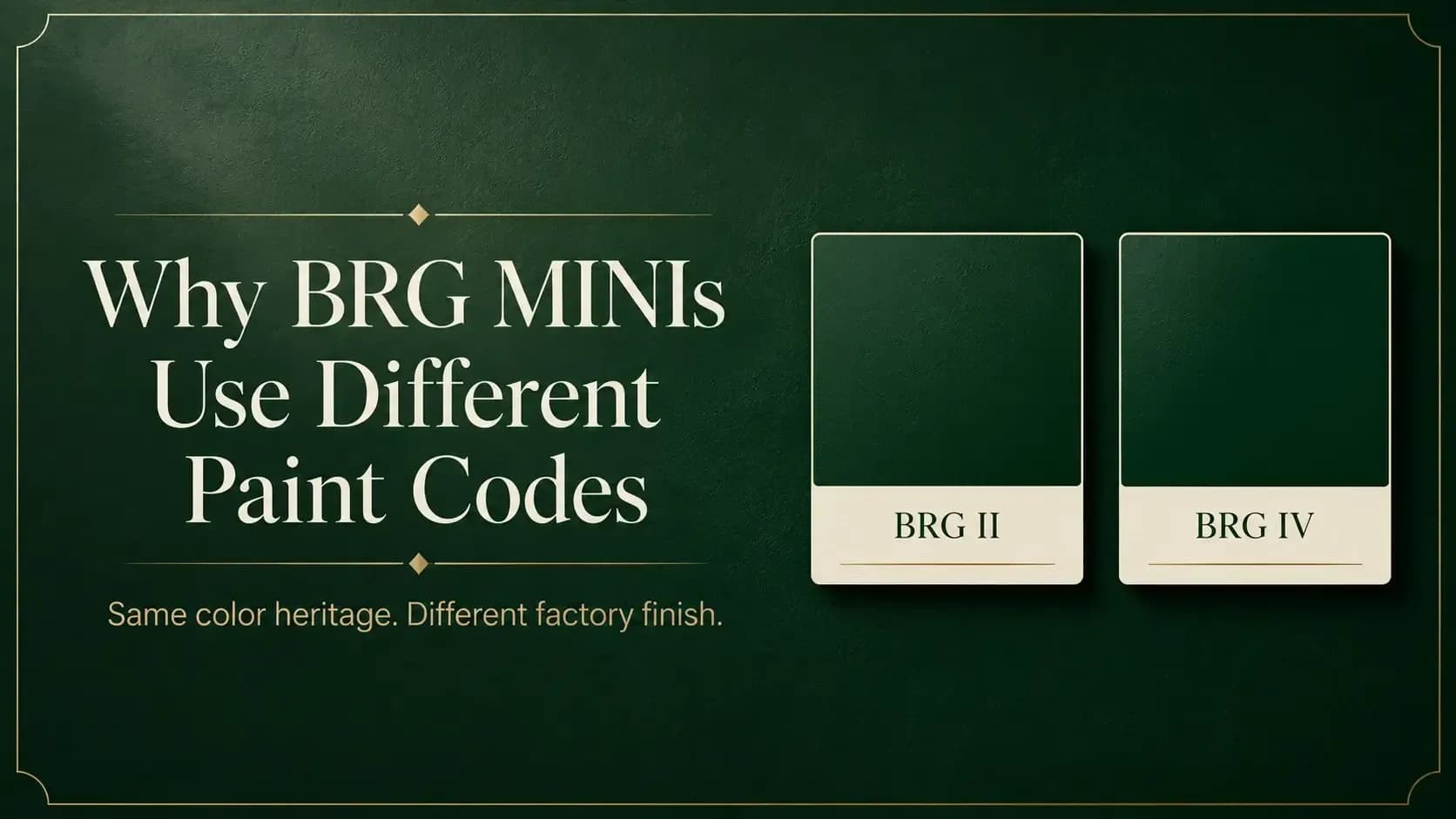
Two MINIs can both be British Racing Green and still have different paint codes. That isn’t a database error or a quirky factory mistake. MINI has revised the color across model generations, creating distinct factory finishes under the same heritage-inspired name.
Before buying touch-up paint, check the exact MINI British Racing Green paint code linked to the car. Start with a MINI paint-code lookup by VIN, then compare the result with the model year, factory label, and original documents.
Key Takeaways
- British Racing Green is a color family, not one unchanged paint formula.
- British Racing Green II and British Racing Green IV are separate factory finishes.
- The paint code, VIN, factory records, and current finish should agree before you order paint.
Why Can Two British Racing Green MINIs Have Different Paint Codes?
MINI has updated British Racing Green as its cars, production periods, and paint systems changed. The historic theme remained, but the exact pigments, metallic effect, and factory designation did not.
Six factors explain most MINI paint code differences:
MINI Revised the Color Over Time
British Racing Green wasn’t frozen in one formula. MINI introduced British Racing Green II for the 2011 model year and described it as lighter and closer to the classic racing green associated with earlier decades. That makes it a revised finish, not merely a renamed version of the previous paint.
Each Version Has Its Own Factory Identity
An official MINI price list identifies British Racing Green II Metallic as paint code B22. That code belongs to a particular factory finish and model range; it does not cover every green MINI carrying the British Racing Green name.
Metallic Effects Change What You See
Metallic paint can look darker straight on, brighter around curved panels, or warmer when sunlight catches the effect particles. That shift is part of the finish, so judging two greens in different light can create a false mismatch.
Professional refinish systems measure color and effect characteristics from several angles because visual matching alone can miss those changes.
British Racing Green IV Arrived Later
MINI introduced British Racing Green IV as a new exterior finish for the 2019 MINI 60 Years Edition. Its official name separates it from British Racing Green II and places it in a later production era.
Availability Varies by Model and Market
Paint choices can differ across a Hatch, Convertible, Clubman, or John Cooper Works model. They may also vary by country and production period.
Official MINI price lists, for example, show B22 British Racing Green II on certain Cooper and Cooper S models but not on every version in the range.
One MINI May Have Been Repainted
The factory record may be right even when the paint in front of you looks different. A replaced bonnet, blended door, repaired quarter panel, or complete respray can change the visible shade without changing the VIN-linked factory color.
Here’s the thing: the color name identifies the family. The code identifies the factory finish.
What Do British Racing Green II and British Racing Green IV Mean?
The Roman numeral is part of MINI’s official color name. It separates one factory interpretation from another, but it is not the alphanumeric paint code used to mix the finish.
Four points clear up the usual BRG 1 vs BRG 2 MINI confusion.
British Racing Green II Is a Defined Finish
British Racing Green II appears in official MINI material as a metallic factory color with code B22. MINI listed it across selected earlier Hatch, Convertible, and Clubman ranges.
That gives owners a firm identification point: B22 British Racing Green II. Still, the code should be confirmed against the specific vehicle rather than assumed from its age or appearance.
British Racing Green IV Is a Later Interpretation
MINI’s 2019 launch material describes British Racing Green IV as a new finish used for the 60 Years Edition. It appeared with contrasting roof colors, anniversary bonnet stripes, and edition-specific trim.
This later finish shares the British Racing Green heritage, but it shouldn’t be treated as identical to B22.
The Roman Numeral Isn’t Enough
“II” and “IV” identify the version name. They do not replace the factory code.
You still need the VIN, model year, paint label, and available factory record before ordering touch-up or refinishing materials. Otherwise, you may have the right color family but the wrong formula.
Informal Names Can Cause Trouble
Searches for MINI British Racing Green 3 may lead to forum posts, classified listings, or paint-seller pages. Treat that wording as a lead, not proof.
Owners sometimes shorten official names. Sellers may also call any deep green MINI “British Racing Green” because that’s what it resembles. This casual wording is one reason MINI Cooper paint-code variations become confusing.
When the physical label is damaged, follow the guide to recovering a MINI paint code when the sticker is unreadable.
How Can You Find the Exact British Racing Green Paint Code on Your MINI?
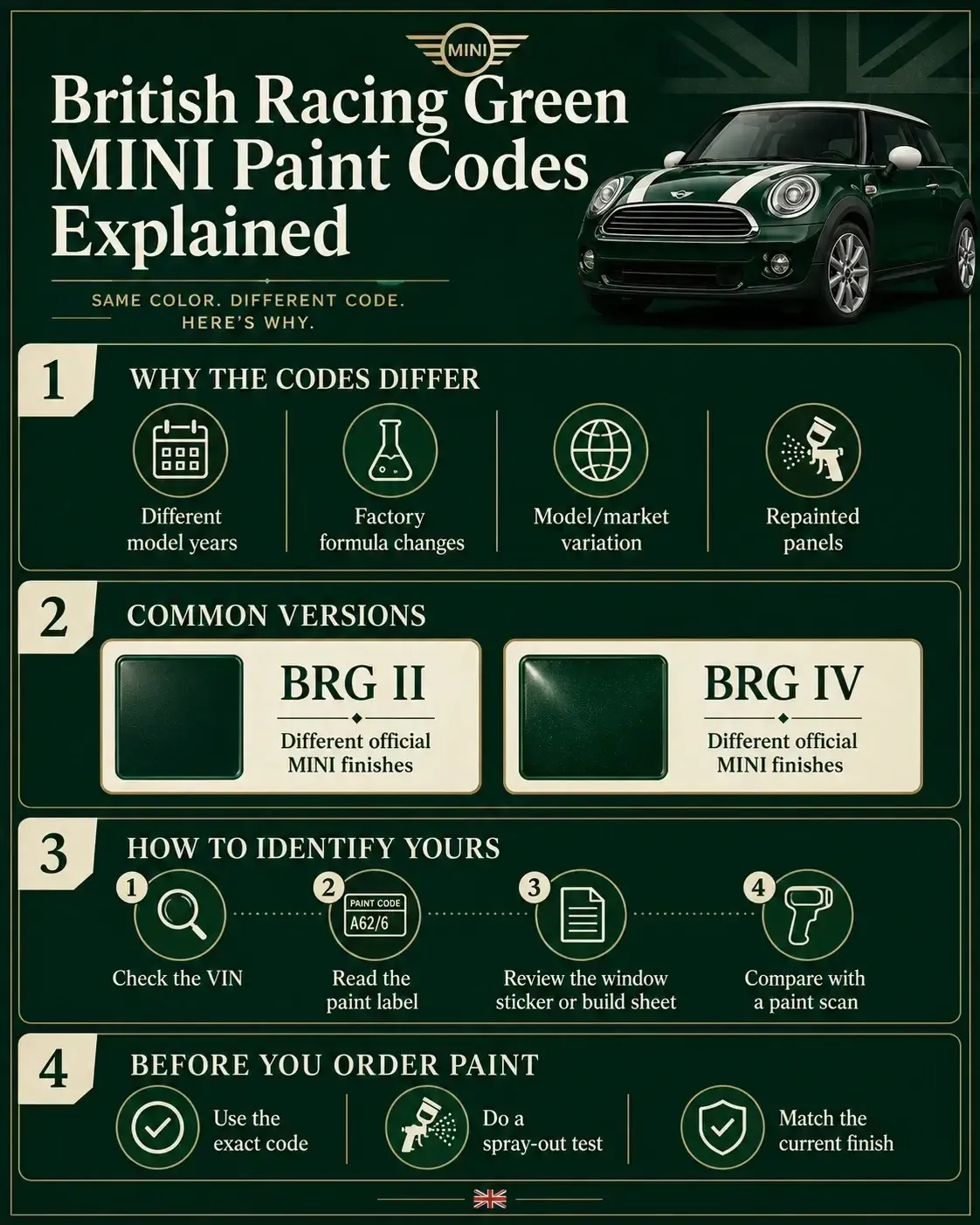
Use several sources together. The VIN confirms the vehicle, while the label and factory records help identify the exact green.
Confirm the Full VIN
Match all 17 characters on the dashboard, registration, title, and door-area label.
Check the Paint Label
Photograph the entire code, including every letter, number, and suffix.
Verify the Model Year
Confirm the production year because British Racing Green versions changed between MINI generations.
Review Factory Documents
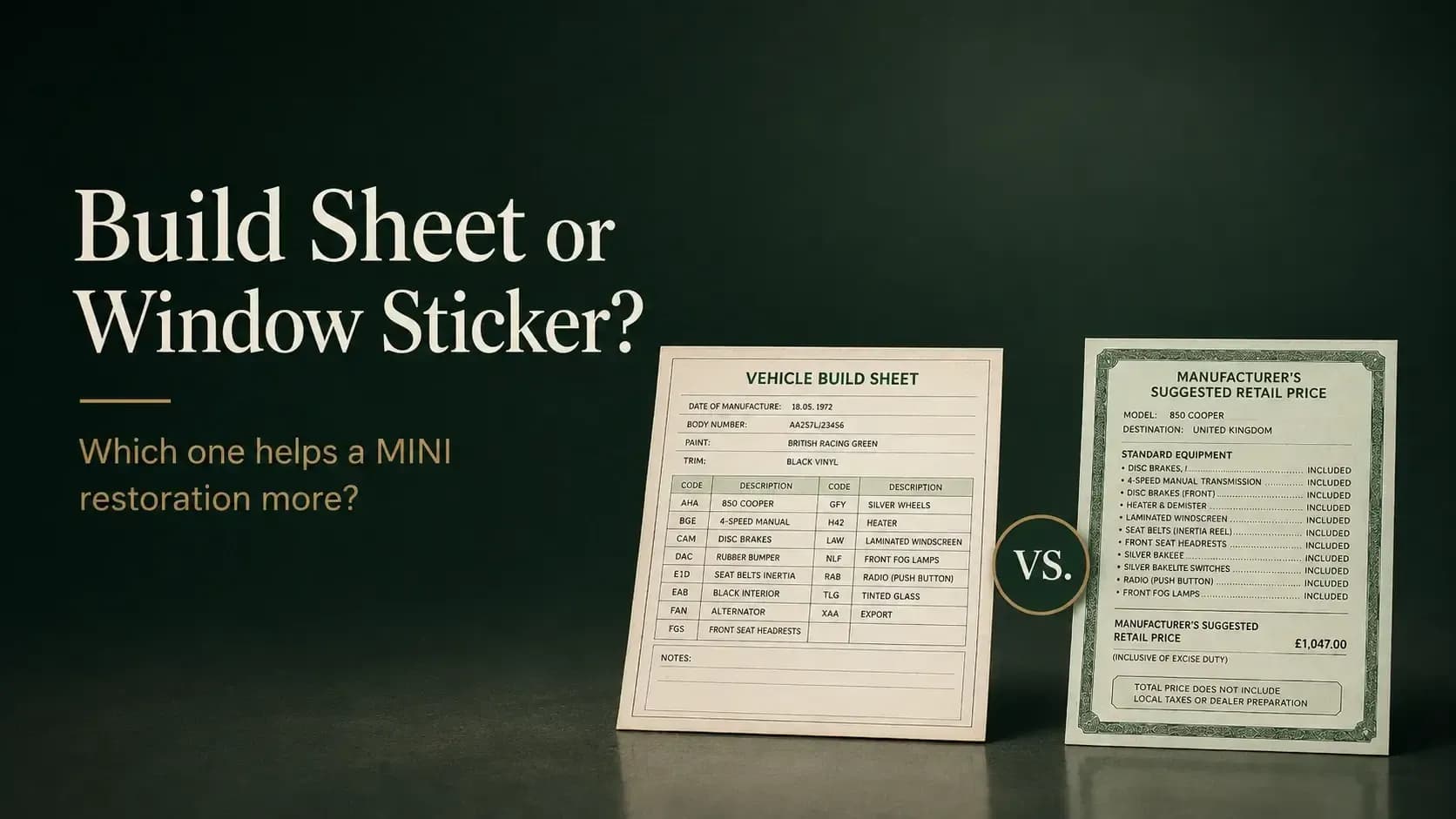
Check the build sheet or window sticker for the original exterior color name.
Compare the VIN Result
Make sure the decoded model, year, color, and physical label support the same answer.
Scan the Current Paint
Ask a body shop to scan an undamaged panel before repairing an older or repainted MINI.
A window sticker may confirm the original exterior color, although it is not the same as a build sheet. The guide to reading a MINI window sticker section by section explains where that information usually appears.
When a decoder returns the wrong model or trim, settle that issue first. Review why a MINI VIN decoder may show the wrong version before relying on its paint result.
Pro Tip: Record the official name and code together. “B22 British Racing Green II” is far safer than ordering paint under “British Racing Green.”
A 2013 Clubman Shows Why the Name Alone Isn’t Enough
Consider the supplied sample for a 2013 MINI Cooper Clubman with VIN WMWZF3C51DT490691. Its factory exterior is recorded as British Racing Green II Metallic.
That places the Clubman in a specific MINI paint period. It shouldn’t be treated as having the same factory finish as a later MINI painted British Racing Green IV.
Now imagine parking that Clubman beside a 2019 60 Years Edition. Both owners might simply call their cars British Racing Green. Fair enough. Yet the cars come from different paint generations.
Add an old bonnet repair to the Clubman, and the comparison becomes even more interesting:
- Original British Racing Green II on untouched body panels
- Refinished green on the repaired bonnet
- British Racing Green IV on the later MINI
Three related greens can appear in one parking space. Only one is the Clubman’s original factory specification.
That’s where paint-code confusion on a MINI often begins. The factory record may be clear, while age, repairs, and casual descriptions blur the story.
Can Two MINIs With the Same Paint Code Still Look Different?
Yes. Matching codes mean the cars began with the same factory color standard. They do not guarantee that both finishes will still look identical ten or fifteen years later.
Four real-world factors can change the visible shade.
Sunlight and Weather Alter the Finish
UV exposure, heat, moisture, road grime, and years outdoors can change how the basecoat and clear coat appear. One MINI may have spent its life in a garage, while another sat outside through every season.
The difference may be subtle indoors and surprisingly obvious in afternoon sun.
Previous Repairs Create Panel Variations
A body shop may have used another refinish brand, a formula variant, or a slightly different tinting adjustment. The result can be close—very close—without disappearing completely.
Bonnet and bumper repairs are common places to notice this because they sit beside several adjoining panels.
Application Technique Affects Metallic Paint
Spray pressure, coat thickness, gun distance, and the way metallic particles settle can affect the finished appearance. The paint formula matters, but application matters too.
That’s why a code alone doesn’t guarantee an invisible panel repair.
Lighting Changes Your Perception
British Racing Green can look almost black in a dim garage, deep green in daylight, and slightly cooler beneath bright LED lamps.
Honestly, that moody character is part of its appeal. It’s also why a phone photograph cannot confirm an exact MINI Cooper green paint code.
Modern spectrophotometers measure vehicle paint at several angles and compare the reading with formula databases. Some systems can adjust the suggested mix when the measured finish differs from the standard formula.
What Should Used-MINI Buyers and Car Flippers Inspect?
A British Racing Green MINI tends to photograph beautifully. Deep paint, chrome trim, a bright roof it’s an easy car to fall for.
Still, glossy listing images may hide mismatched panels or the wrong factory-color description. Check these four areas before buying or setting a resale price.
Compare Every Panel in Natural Light
Walk around the car outside and view the bonnet, doors, bumpers, roof, and rear quarters from several angles.
Look again from a few steps away. A color difference that disappears up close may stand out when you see the car as a whole.
Inspect Edges and Hidden Areas
Look around door seals, hinges, panel bolts, trim edges, wheel arches, and the underside of the bonnet.
Overspray, masking lines, disturbed bolts, or a different shade inside the door opening can reveal earlier body work or a full color change.
Compare the Listing With Factory Records
A seller may describe the car as British Racing Green because that’s what the paint looks like. The original specification may show another green version or another color altogether.
That doesn’t always mean the seller is being dishonest. Many people simply repeat the wording from a previous listing. See why a used MINI listing may not match its original window sticker before treating the advertisement as factory proof.
Price the Paint Risk Properly
A stone chip is a small issue. A mismatched bonnet, peeling clear coat, or poorly prepared respray is a different story.
For a car flipper, paint risk affects margin. For an enthusiast, it affects how much work the car will need before it looks right. Either way, get a body-shop opinion when the shade raises questions.
How Should You Order British Racing Green Repair Paint?
Start with verified factory information, but don’t stop there. The factory code points to the original formula; the car’s current condition determines whether that formula will match without adjustment.
Four safeguards can prevent an expensive green patch.
Order With the Full Vehicle Details
Give the supplier the exact paint code, full VIN, model year, and body style. Don’t order using only “British Racing Green” or “dark green MINI.”
Those broad names leave too much room for the wrong formula.
Ask Whether Formula Variants Exist
A refinish database may contain more than one field variation for a factory code. These alternatives account for differences seen in production and aging vehicles.
Ask the painter or supplier to compare available variants rather than accepting the first formula on screen.
Request a Spray-Out Card
A spray-out card shows how the mixed paint looks after the intended application and clear coat. Hold it beside the MINI in daylight, shade, and workshop lighting.
This simple step is much more reliable than choosing from a website image or printed paint chart.
Discuss Blending Before the Repair
On an older MINI, a perfect edge-to-edge panel match may be unrealistic even with the correct code. Blending color into an adjoining panel can make the transition less visible.
The painter should make that call after seeing the car, not after reading the code over the phone.
Pro Tip: Scan a clean, undamaged panel close to the repair. Avoid the faded roof, scratched bumper, or any panel that may already have been repainted.
What Mistakes Cause British Racing Green Paint Mismatches?
Most costly paint problems begin with a shortcut that seemed harmless. Unfortunately, “close enough” green rarely stays invisible once the MINI is back outside.
Avoid these four common errors:
⚠️ Ordering by the Color Name Alone
British Racing Green is not one universal MINI formula. Without the exact code and vehicle details, you may receive the wrong generation of the color.
⚠️ Trusting One Unverified Lookup
A mistyped VIN, incomplete database, or result tied to another market can point to the wrong finish.
Compare the result with the physical label and factory documents before treating it as final.
⚠️ Scanning the Wrong Panel
A scanner reads the paint placed beneath it. If that panel was repaired before, the machine may reproduce the old repair instead of the surrounding original finish.
Check several panels and choose a sound area close to the new repair.
⚠️ Skipping the Test Sample
Never approve a full-panel repair from a screen preview, paint-can lid, or color name.
A spray-out sample gives you one final chance to catch a mismatch before the paint reaches the car.
Conclusion: Same Heritage, Different Factory Finish
British Racing Green is one of MINI’s most recognizable color identities, but it isn’t one shade that remains unchanged forever.
Official MINI material identifies British Racing Green II as B22 on earlier model ranges. MINI later introduced British Racing Green IV as a new finish for the 2019 60 Years Edition. Both belong to the same heritage story, but they represent different factory paint specifications.
That is why two green MINIs can look different without either car being incorrectly described.
To identify the correct MINI British Racing Green paint code, confirm the VIN, inspect the label, check the model year, and compare the available factory documents. For repair work, verify that information against the paint currently on the car.
Before buying touch-up paint or approving body work, check your MINI’s factory paint information by VIN. One careful check can prevent a very visible mistake.